A curated route through major people, places, and movements so a first-time reader can follow the unfolding story.
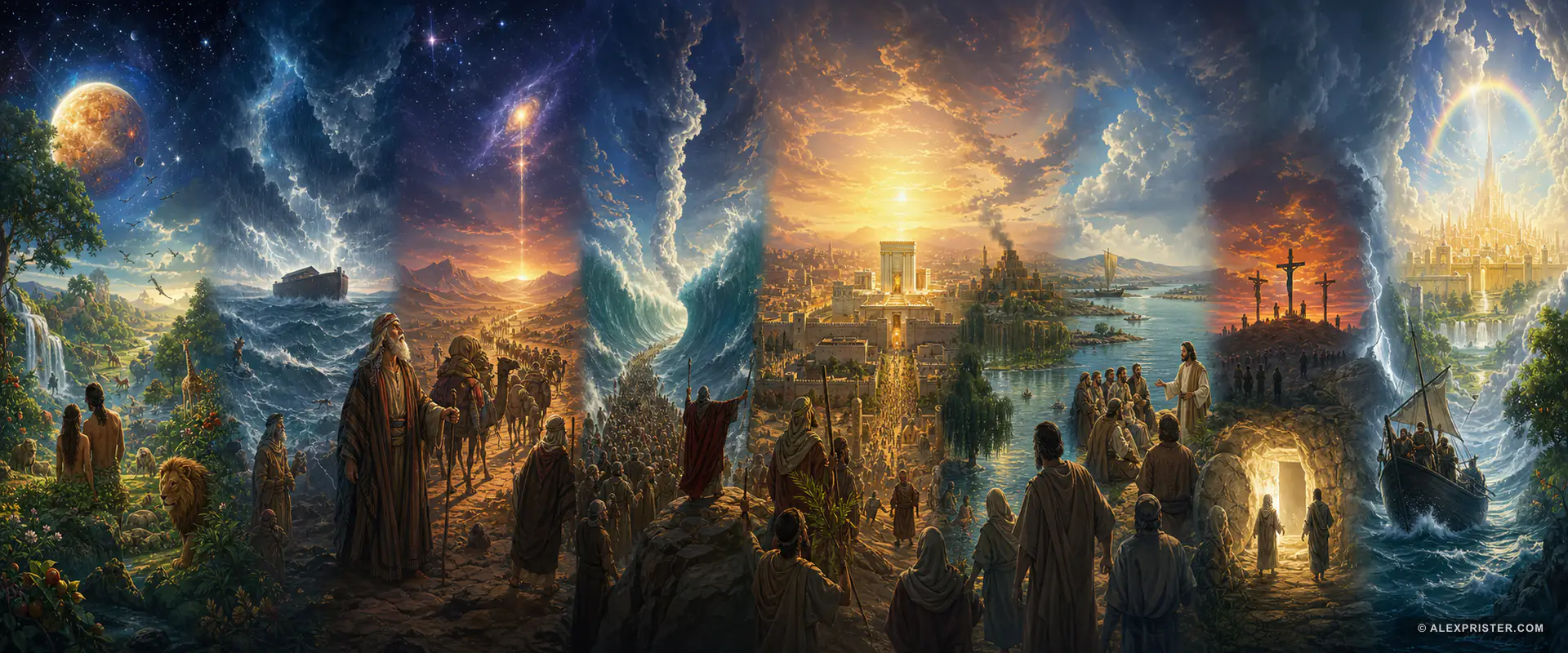
Complete illustrated reading edition / every book / every chapter
The whole
Bible.
Scripture · modern context · illustration · map
Start at Genesis 1:1 and read continuously through Revelation 22:21. Every chapter preserves the Bible text, then clearly separates 8,758 passage-level study units, modern perspectives, original art, and responsible geography.
Open Genesis 1 ↓66books
1,189chapters
31,103source verse records
0commentary disguised as Scripture
Opening the complete Bible corpus…
Loading only the requested chapter so the reader stays fast.
Optional cinematic close-ups / after the complete reader
Go deeper into
the movement.
The complete reader above is the Bible from beginning to end. The scenes and atlas below are additional visual exhibits: a verse-level Abraham read-along, difficult-to-pin opening narratives, and 16 selected mapped journeys.
Read the Bible / first complete guided passage
Read it.
Watch it move.
The numbered journey follows selected episodes in the Bible's storyline, beginning in Genesis and moving forward through the Protestant canonical sequence. It is a guided reading path, not a complete table of contents and not a claim about when each book was composed.
The familiar book order in the 66-book Protestant Bible. Jewish, Catholic, and Orthodox canons arrange and include some books differently.
Scholarly estimates of when texts reached their written forms. Dates and stages are debated, so there is no single universally accepted composition-order list.
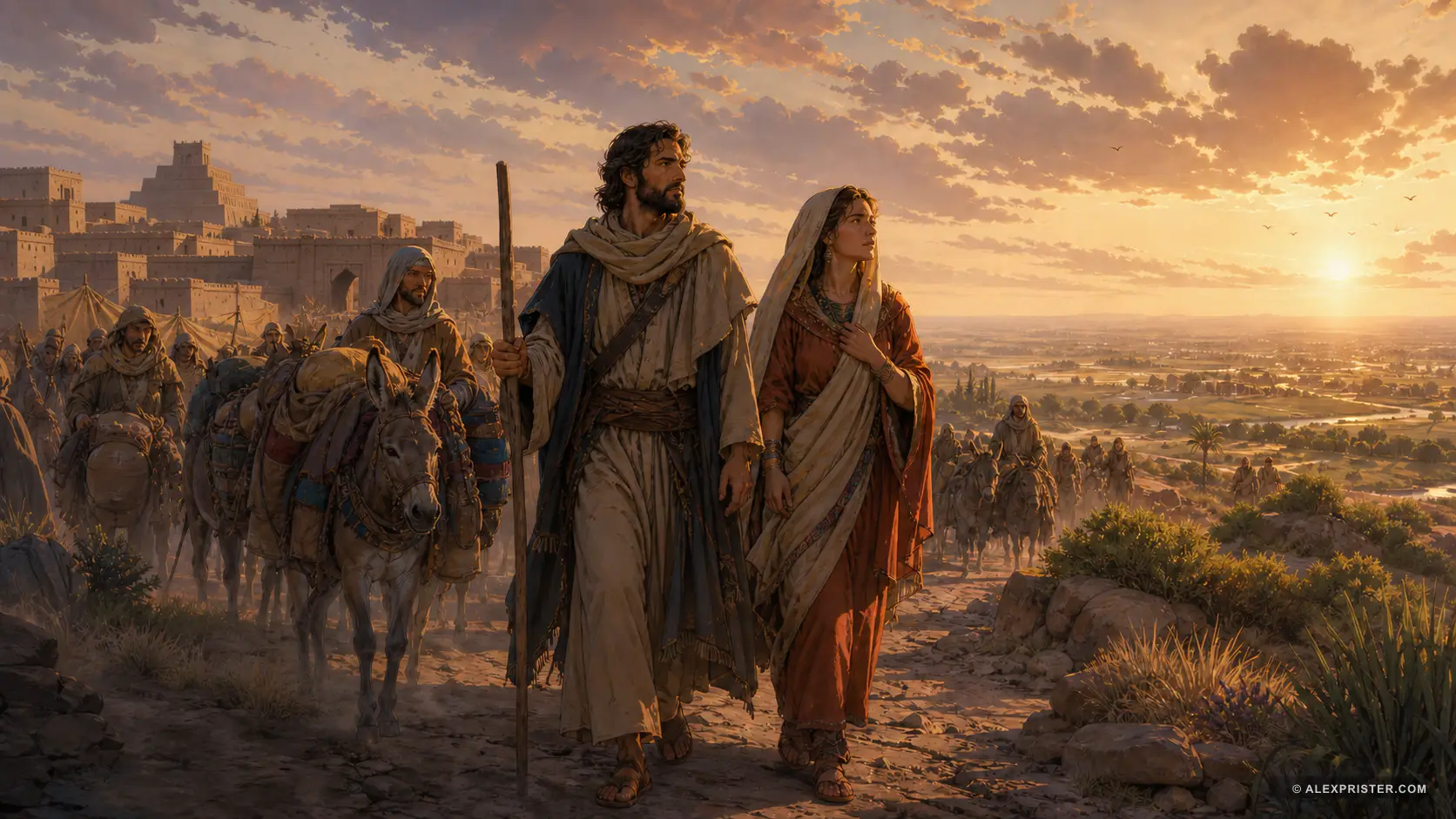
Scene 1 of 6: A family leaves Ur and stops in HaranGenesis 11:27–32Verify in the official WEB text ↗ What happens Why it matters Historical context What the map infers
A family leaves Ur and stops in Haran
Genesis 11:27–32
- 27Now this is the history of the generations of Terah. Terah became the father of Abram, Nahor, and Haran. Haran became the father of Lot.
- 28Haran died in the land of his birth, in Ur of the Chaldees, while his father Terah was still alive.
- 29Abram and Nahor married wives. The name of Abram’s wife was Sarai, and the name of Nahor’s wife was Milcah, the daughter of Haran, who was also the father of Iscah.
- 30Sarai was barren. She had no child.
- 31Terah took Abram his son, Lot the son of Haran, his son’s son, and Sarai his daughter-in-law, his son Abram’s wife. They went from Ur of the Chaldees, to go into the land of Canaan. They came to Haran and lived there.
- 32The days of Terah were two hundred five years. Terah died in Haran.
Genesis narrows from a genealogy to one household. Terah sets out for Canaan with Abram, Sarai, and Lot, but the family settles in Haran. Loss and infertility are already present before Abram's call begins.
The promise that follows does not begin with a triumphant dynasty. It begins with bereavement, an unfinished migration, and a couple who have no child—the precise conditions the later promise will confront.
Ur in southern Mesopotamia is the conventional identification of “Ur of the Chaldees,” and ancient Harran was an important city in northern Mesopotamia. Genesis does not date this journey, and neither identification independently verifies this family narrative.
The two endpoints are named in the text. The curved line is a modern explanatory corridor around the Fertile Crescent, not a recovered road, daily itinerary, or GPS track.
Scripture text in the numbered verse panels is reproduced unchanged from the public-domain World English Bible. Headings, explanations, historical notes, and map cautions are original editorial material. Public-domain notice ↗ Modern map terrain is orientation context, not a reconstruction of the ancient landscape.
Scene 1 of 6: A family leaves Ur and stops in HaranGenesis 1–11 / before a route can honestly be drawn
The atlas begins
without a pin.
Not every important story should become a coordinate. These opening narratives establish the world, the human problem, judgment, mercy, and dispersion before the mappable journey of Abraham begins.
Creation & Eden
The story opens as theology and sacred cosmology: a world called good, human beings bearing dignity, and a garden lost. Genesis gives rivers and place-language, but not a recoverable set of Eden coordinates.
Intentionally unpinnedFlood & Ararat
The ark comes to rest on the ‘mountains of Ararat’—a broad ancient region, not a named modern summit. Flood traditions belong in the story; an exact landing pin would manufacture certainty the text does not provide.
Region named; summit unknownBabel & Shinar
A city and tower in Shinar stage a meditation on power, ambition, language, and scattering. Southern Mesopotamia supplies context, but no excavated ziggurat can be labeled ‘the Tower of Babel’ as an established fact.
Contextual, not identifiedGuided Map Journeys / Genesis to Acts
Sixteen mapped journeys.
No invented borders.
This is a selective story-sequence atlas—not a complete Bible index and not the disputed order in which the books were composed. The story layer adds routes and places, not reconstructed ancient borders; editorial connectors are never treated as ancient GPS recordings.
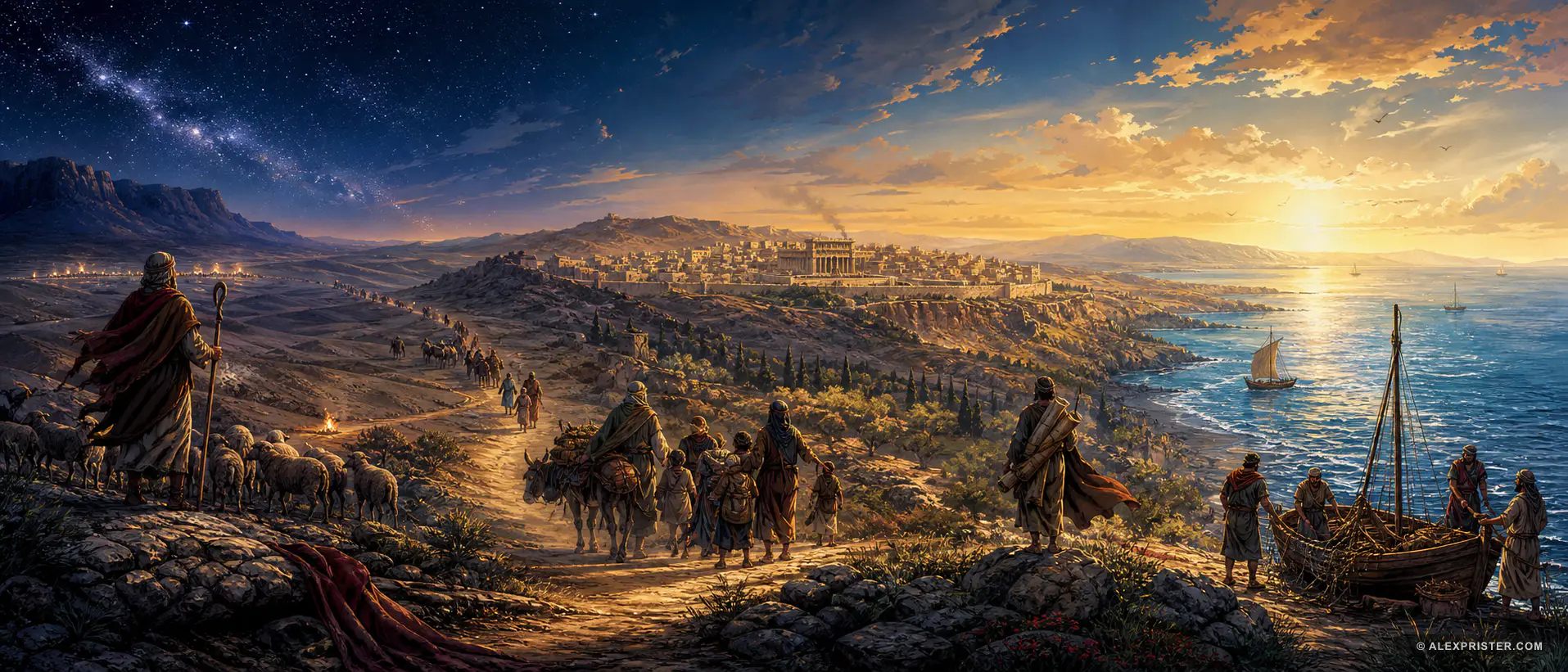
Original plate
Original storyscape / period-informed imagination, not archaeological evidence
01 / Genesis 11–13 / Abraham’s first journey
Abraham & Sarah — the first journey
The opening movement, not the whole Abraham cycle.
Abram and Sarai leave Harran, enter Canaan, move through Shechem and the hill country, face famine in Egypt, return, and separate from Lot. Later Abraham narratives continue through Genesis 25 and are not summarized as though they happened here.
Why it mattersFaith is presented as movement without complete certainty; covenant brings responsibility as well as blessing.
Genesis 11:27–13:18Biblical narrative · Named places · Route reconstruction · Open question
Building the atlas view…
Loading the map, route overlays, and terrain.
Open cartographic atlas · present-day baseThe named sequence bends through the Fertile Crescent. It is an explanatory caravan corridor, not a recovered road or daily itinerary.
Narrated movementReconstructionLater traditionContestedSea corridor
The named sequence bends through the Fertile Crescent. It is an explanatory caravan corridor, not a recovered road or daily itinerary.
Southern Ur is the conventional identification of 'Ur of the Chaldeans,' but it is not certain. Abraham is not independently attested, and no exact travel track survives.
Keyboard-readable map ledger
Places
- Ur / Tell el-Muqayyarcontested
Conventional southern identification; the biblical identification is not certain.
- Harrannamed
Named stop in the Genesis sequence.
- Shechem / Tell Balatanamed
Ancient place anchor; the drawn connector is representative.
- Bethel / Beitincontested
Traditional scholarly identification with some continuing debate.
- Hebron / Tell Rumeidanamed
Named ancestral setting.
Routes
- Named sequence / representative caravan corridorapproximate
The arc follows plausible geography between named places; intervening roads are not supplied by Genesis.
Source drawer3 records for this chapter
textWorld English BibleeBible.org
Public-domain English text used as the reference edition for this atlas. Narrative copy on this page is original paraphrase.
↗placesPleiades ancient-place gazetteer (CC BY 3.0)Pleiades contributors / Institute for the Study of the Ancient WorldOpen scholarly place records and contributor-authored coordinates. A point locates an ancient place; it does not prove every event associated with it.
↗archaeologyThe Ahwar of Southern Iraq: cities of Uruk, Ur and EriduUNESCO World Heritage CentreMaterial context for southern Mesopotamia and the conventional identification of biblical Ur.
↗Evidence grammar / always visible
Know what kind
of claim you see.
Biblical narrative
What the named biblical book narrates.
Named place
A location explicitly named by the text and reasonably identified.
Route reconstruction
An editorial connection between named places, never a GPS track.
Historical context
A city, empire, custom, or event supported beyond this particular narrative.
Later tradition
A later Jewish or Christian location or devotional identification.
Open question
Geography, chronology, archaeology, genre, or authorship remains disputed.
Faith claim
A theological or miraculous claim that a map cannot prove or disprove.
Reading room / full project ledger
Open the record.
Then question us.
01text / eBible.orgWorld English Bible
Public-domain English text used as the reference edition for this atlas. Narrative copy on this page is original paraphrase.
↗02places / Pleiades contributors / Institute for the Study of the Ancient WorldPleiades ancient-place gazetteer (CC BY 3.0)Open scholarly place records and contributor-authored coordinates. A point locates an ancient place; it does not prove every event associated with it.
↗03places / Brughmans, de Soto, Pazout, and Bjerregaard Vahlstrup (2024)Itiner-e: the roads of the Roman EmpireCC BY 4.0 Roman-road context. Roads are plausible corridors only unless a biblical text explicitly names them.
↗04map / Natural EarthNatural EarthPublic-domain global physical geography used for whole-world orientation.
↗05map / OpenStreetMap contributorsOpenStreetMap dataPresent-day geography beneath the source-classified story overlays; licensed under ODbL.
↗06map / OpenFreeMap; data copyright OpenStreetMap contributorsOpenFreeMap / OpenMapTiles base mapPresent-day cartographic context only. Modern roads, labels, and boundaries are not presented as ancient geography.
↗07map / MapterhornMapterhorn global terrainModern elevation context for 3D relief. Terrain does not reconstruct ancient buildings, roads, coastlines, or land use.
↗08method / Bible Odyssey / Society of Biblical LiteratureHow does the New Testament relate to history?A useful introduction to keeping literary, theological, and historical questions distinct.
↗09method / American Society of Overseas ResearchSinai journeys and historical geographyDiscussion of the Jebel Musa tradition and southern Sinai identifications. It does not solve the Exodus route or substantiate every candidate point shown here.
↗10method / Second Vatican CouncilNostra aetate, paragraph 4A major Christian rejection of collective Jewish guilt for the Passion. The atlas pairs this moral guardrail with the historical fact of Roman crucifixion.
↗11archaeology / UNESCO World Heritage CentreThe Ahwar of Southern Iraq: cities of Uruk, Ur and EriduMaterial context for southern Mesopotamia and the conventional identification of biblical Ur.
↗12archaeology / UNESCO World Heritage CentreAncient Jericho / Tell es-SultanJericho is an extraordinary ancient settlement; its long archaeological sequence is not a one-line proof of Joshua's account.
↗13archaeology / The Jewish MuseumTel Dan Stele / House of DavidAn important external dynastic anchor, not independent confirmation of every episode in David's biography.
↗14archaeology / The British MuseumBabylonian Chronicle of Nebuchadnezzar's campaignExternal evidence for the 597 BCE campaign against Jerusalem.
↗15archaeology / The British MuseumThe Cyrus CylinderComparative evidence for Persian restoration policy. It does not name Judah or independently reproduce Ezra's decree.
↗16archaeology / UNESCO World Heritage CentreBirthplace of Jesus: Church of the NativityEvidence for an enduring Bethlehem tradition, not archaeological proof of the birth narrative.
↗17archaeology / UNESCO World Heritage CentreBaptism Site 'Bethany Beyond the Jordan'Late Roman and Byzantine commemoration of the baptism tradition at Al-Maghtas.
↗18archaeology / UNESCO World Heritage CentreArchaeological Site of PhilippiMaterial and road context for Paul's visit to the Roman colony on the Via Egnatia.
↗19archaeology / UNESCO World Heritage CentreEphesusSecure archaeological context for one of the best-attested cities in Acts and the Pauline world.
↗20map / NASA EOSDISNASA Global Imagery Browse ServicesDated modern satellite context. It is not a reconstruction of the ancient landscape.
↗Historical and moral guardrail
The Passion must never become collective blame.
Jesus, his family, his first followers, and the earliest Jesus movement were Jewish. The Gospel narratives describe particular actors within a complex first-century setting; they do not indict the Jewish people across time.
Crucifixion was Roman punishment carried out under Roman imperial authority. Collective blame against Jewish people is historically false, theologically destructive, and morally indefensible.